The era of autonomous AI cyberattacks is here
 Łukasz Wróbel ·
According to Google, the era of autonomous AI cyberattacks is here. And I don’t think we know how to deal with it.
Last week I referenced a report published by Google Threat Intelligence Group. I’m afraid I have to do something similar again. The reason is that an automated attack was carried out. It read patches, wrote an exploit, and ran it, without a human in the loop.
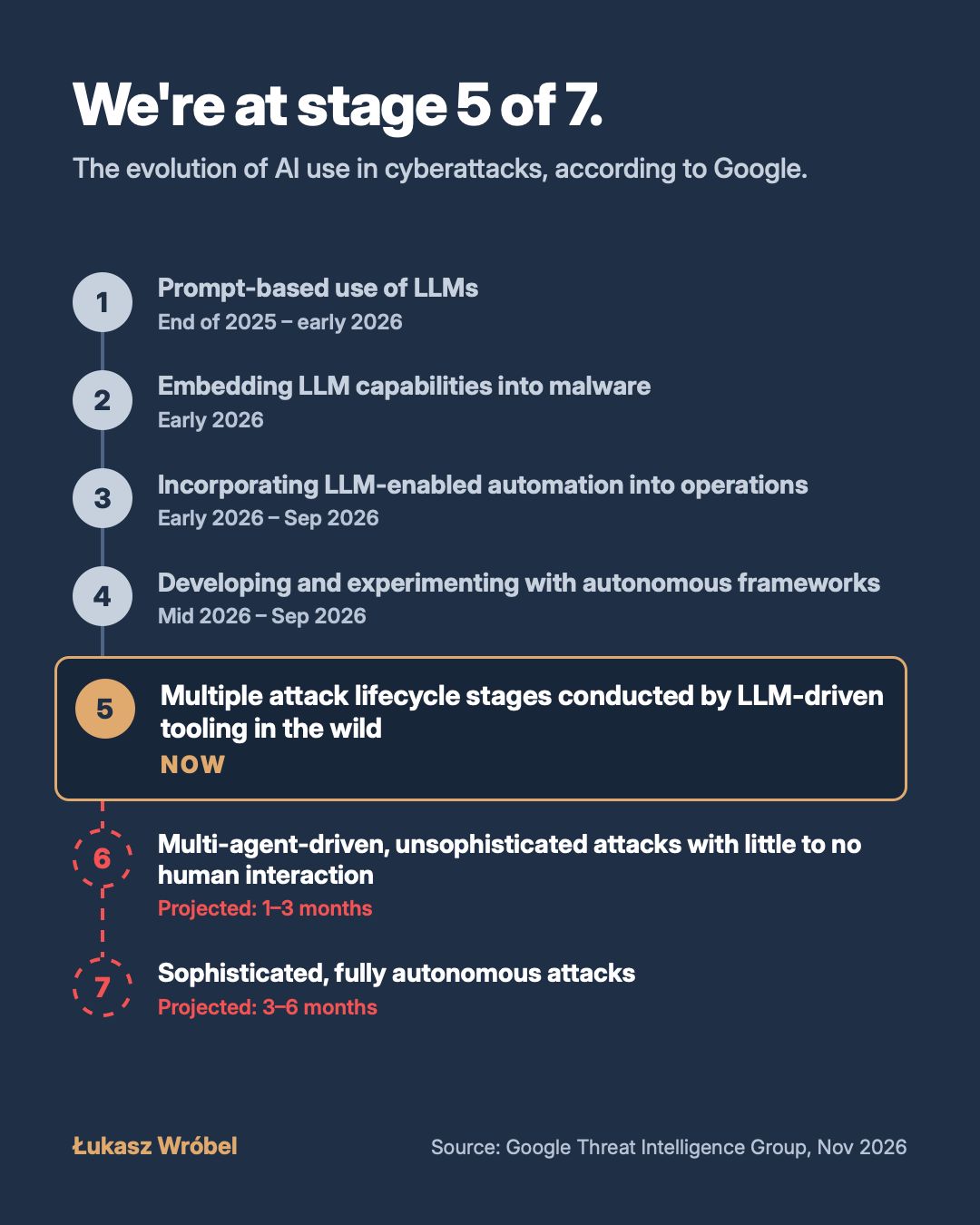
According to Google, we’re at stage 5 of 7 in the evolution of AI use in cyberattacks, now happening in the wild. The progression to the final stage (sophisticated, fully autonomous attacks) is projected to happen within the next few months.
I don’t think we, as an industry, are keeping up. How good are the existing defense tools? I would take vendors’ claims with a grain of salt, but there was DARPA’s AI Cyber Challenge last year. According to DARPA, AI found 54 of the 63 planted vulnerabilities and patched 43. Interestingly, AI found 18 vulnerabilities that weren’t planted. So it looks like AI can be helpful on both sides of cybersecurity. And without AI on the blue team, soon there’ll be no way to keep up with the attackers.
I’ve seen quite a few cyberattacks in my career. In the past, if you were an attractive target, you could get yourself a focused, tailored attack. If you ran a popular tool like WordPress, there were automated scanners knocking on your door. Soon, there will be no difference. A tailored attack will get cheap enough that everyone’s door gets knocked on.